
Finding a Different Seat at The IEP Table: A Special Educator's Journey Raising an Autistic Child

I’m Felicia, one of the founders of Something to Say ABA. In this series, I’m sharing the pivotal, real-life moments behind my practice. If you missed how we helped my classroom students find their voices and how I found mine, catch up on part 3 here. Today, I’m sharing the most personal chapter of my journey—the story of the most important child to ever walk into my classroom.

If you've been following along with our story, you know we just wrapped up my time in the STEP classroom. Chronologically, this chapter belongs exactly here, right in the middle of our series, before we fast forward to the chaos of COVID-19.
But full disclosure: this was actually the very last post I wrote. I kept putting it off. I didn’t know how I could possibly capture the profound rollercoaster of emotions that comes with loving and losing a child, and I have been paralyzed by the fear that whatever words I put on this page simply won't do him justice.
But to truly understand my journey towards opening Something to Say ABA you have to meet him. You have to meet the most important child to ever walk into my classroom. To protect his privacy, I’ll call him Cubadie-Patoobadie because that is the incredibly adorable way that he used to pronounce "cutie patootie."
A Connection Bigger Than the Classroom
Looking back, I find it almost funny how terrified I was to learn I would be receiving a new student who was not only autistic but also significantly visually impaired. I spent sleepless nights agonizing over whether I was equipped to support him. So many accommodations I worked with were VISUAL. Despite the panic, when this tiny, fiery redhead with spiky hair walked through the door, he completely stole my heart.

When we first met, he had almost no vocal speech, but he filled the room with his own unique soundtrack—rhythmic clicking, humming songs, and sudden screeches of happiness. Of course, every so often, that joyful humming would be broken by a perfectly timed, completely unexpected cuss word. You had to bite the inside of your cheek to keep from laughing while redirecting him, secretly marveling at his absolute audacity.
Despite my fierce love for him and my best efforts to accommodate him in a classroom designed around visual supports, I had to be brutally honest: my classroom wasn't the best fit for his complex needs. We were deep in the bureaucratic trenches trying to secure a specialized placement when I received news that derailed everything.
It didn't come from an official email; it came through a convoluted game of telephone that traced back to the school bus driver. His foster care placement had just fallen through.
The news hit me like a ton of bricks: his foster care placement had just fallen through.
Suddenly, the carefully laid plans for his specialized educational placement felt completely irrelevant. How could we worry about what classroom he belonged in when he didn't even have a home to go to at the end of the day? My heart pounded in my chest. This tiny, vulnerable kid with the spikey red hair and the sparse, colorful vocabulary was floating in the wind. I couldn't let that happen.
The Storage Room Pitch: Becoming a Family for a Child with Autism

At lunch, I slipped into the cramped, dimly lit storage room attached to the staff lounge. Wedged between boxes of laminating film and construction paper, my hands shaking, I called Matt, who at the time I called my fiancé.
"His foster placement fell through," I whispered into the phone. "He has nowhere to go. What if... what if we took him in?"
I braced myself for a long sigh or a list of logistical concerns. Instead, I got the response that made me absolutely certain I was going to marry this man. There was no hesitation, no request for a pro/con list, no "let's talk about it tonight." Without missing a beat, he simply agreed. In that cramped storage closet, surrounded by school supplies, the trajectory of our lives pivoted completely. We weren't just going to be Cubadie-Patoobadie's advocates anymore. We were going to be his family.
Parenting in the Trenches: The Realities of Raising a Neurodivergent Child
What started as an urgent, interim placement turned into nearly five years, before we had even realized it. His smile was infectious, his love was completely pure, and simply being with him made every day better. We filled the days with tickles, swimming, swinging, and basking in the sunshine. Over time we curated the most outlandish, genre-defying playlist of songs that spoke to his soul…and got stuck in my head. But nothing elicited more pure, squealing delight than "walk on the ceiling"—a game where Matt would hold him upside down by his feet, letting him stomp his way right across our living room ceiling.

He quickly became the center of our universe. When Matt and I finally tied the knot, our little guy was there dressed in a tiny suit holding a ring bearer pillow and his white-cane. When we brought our newborn son home from the hospital, Cubadie-Patoobadie was the very first person to hold him. He became so intertwined in our lives that there was no way either of us could picture our future without him.
But although our time with Cubadie-Patoobadie were filled with joy, they were also exceptionally challenging.
As a young educator I thought that I was empathetic to the trials of raising a child with special needs. After all, I had watched Amy navigate these challenges with Ivy throughout my entire life. The stark reality is: until you are the one living it, you just don’t get it.
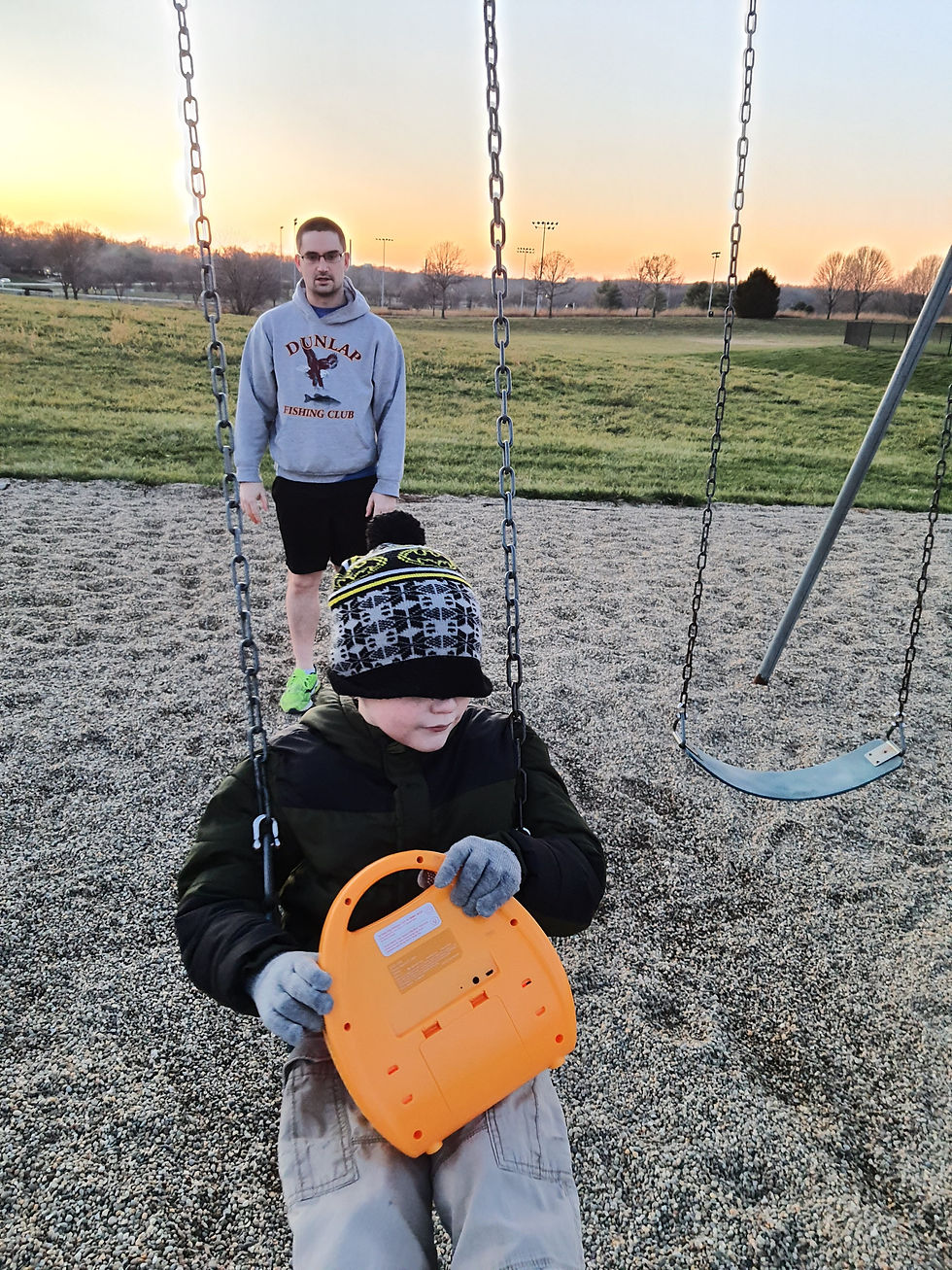
You don't know the panic of performing midnight triage—trying to decide if your screaming child is just overstimulated and needs a hug or if you need to rush to the ER. You also don’t understand the following embarrassment when you put said screaming child into car and he instantly starts making his happy sounds, and you question why you jumped to such a conclusion.
You don’t understand the knot of absolute terror in your stomach when you have to send your practically non-verbal son onto a school bus, out of your care for the very first time. You don't know the physical and emotional heartbreak of having to block your child from headbanging during a severe meltdown. Or the bizarre reality of having to buy a brand new light fixture because he figured out how to climb the dining room table to mess with the chandelier. You haven't felt the stomach-dropping terror of finding him in the garage surrounded by tools and chemicals, sparking a desperate hunt for specialized locks he couldn’t crack.

Parenting in the trenches means surviving screaming haircuts and executing stealthy, midnight toe-clippings. It means experiencing the unique, mind-numbing fatigue of hearing "The 12 Days of Christmas" on a continuous loop for months on end, because that is the only thing that will keep him regulated. It's the quiet panic that makes you buy and hoard his favorite toys on the off chance the company discontinues it, or the sheer terror of staring at bare grocery store shelves during a pandemic, realizing his only safe foods are completely gone.
And you certainly don't understand the blinding frustration of sitting across from service providers who dismiss your input. (Yes, I absolutely handed his speech therapist an inch-thick stack of highlighted peer-reviewed research papers to prove why he didn’t need to demonstrate "readiness" skills to start using an AAC device).
Unlocking His Voice: The Power of AAC Devices and Customized Support

Living on the other side of the IEP table was exhausting, but the victories were breathtaking. Our most treasured honor was unlocking his voice. Although I had extensive knowledge in AAC from my time in the STEP classroom, Cubadie-Patoobadie couldn’t access any of the systems I was familiar with. I eventually discovered cards that had different items attached to them to symbolize different needs. We worked with him each day until he was able to independently ask for a few key things. But he still faced so much frustration with his limited vocabulary. He would use his cards request “play” but when I brought him one of his favorites toys, he would chuck it across the room. I would enter a cycle of guess and dodge until the right one finally touched his hands. He could request “play,” “eat,” and “drink,” but rarely were those specific enough to provide our opinionated little guy what he was looking for.

Luckily, I was attending a training on alternative communication when the speaker introduced a high tech communication device that had a newly developed tactile key guard to guide individuals to the correct buttons by touch despite them being unable to see the screen. We were able to program so many more words into the tablet than we would ever be able to carry in a binder. He continued to build his vocabulary and request his needs more easily, but he still couldn’t be as specific as he wanted to be. Being able to say, “light up toy” doesn’t help much when all your toys light up. His BCBA had a brilliant, life-changing idea: give each toy it’s own unique name. She suggested something so simple, that I was embarrassed I didn’t think of it. So, we took a permanent marker and wrote a specific name directly on every single one—"blue bus," "disc toy," "space spinner." This ensured everyone called it the exact same thing.

The transformation was staggering. He went from frantically searching and melting down to having the exact words to ask for his prized possessions. Those button presses turned into vocal speech and we ended up phasing out the communication device because he was learning to vocally say words faster than he could learn the location of the word in the device. We equipped him with the tools to advocate for his needs and interact with his environment. He took that momentum and built a robust vocabulary, unlocking a level of engagement that was truly meaningful to him.
Finding his vocal voice didn't just help him get his needs met—it gave the brilliant personality he already had a delightful new way to express itself. We spent hours joyfully reciting entire stories and jokes memorized from his "storybook rhymes" toy. He was able to tell me, “you are my best friend” and ask me to “turn on” when the sun disappeared behind the storm clouds. He developed the hilarious habit of tattling on himself. Whenever that mischievous boy was about to do something he knew he wasn't supposed to, he would loudly announce, "Not for Cubadie!" right before breaking the rule anyway. And I’ll never forget the day he invented his own word: "sock-ser-nail." It was his custom term for the annoying little pills of fuzz on the bottom of his socks—a linguistic mashup of "socks" and "nail" (a word he learned from a hangnail, which hilariously led him to get the nail clippers and have me "clip" the fuzz off his socks).

But nothing compares to a simple car rides to ABA therapy. I had my mom on speakerphone, and just as she had done faithfully for years, she asked, "How are you?" After years of silence, a little voice chimed in from the back seat: "Pretty good." By the end of our time together, he had a voice.
The Hardest Goodbye: Transforming Personal Grief into Professional Grace
Foster care is a system built on temporary harbor. Every parent of a child with profound needs wrestles with one terrifying question in the quiet of the night: Will he be okay when I am gone? It is a heavy, lingering fear usually reserved for the end of a lifetime. But because of the foster system, my husband and I had to face that agonizing reality decades too early. After five years of being our son in every way that mattered, he left us and returned to his biological father.

The transition was devastating in itself, but the true heartbreak was when his father closed the door on our relationship with him. Just as quickly as he had come into our lives, he disappeared, lost to us forever. When that door shut, we lost our ability to protect him. We had to trust that the foundation we built together—the words we helped him find, the self-advocacy he learned—would be enough to carry him through a world that we were no longer allowed to guide him through.
Losing him ushered in a season of grief I couldn't have prepared for. It created a new, entirely indescribable emotion—a place in my heart where profound joy and agonizing sadness are permanently intertwined. But that heavy, beautiful, indescribable emotion is exactly what I carry with me into my career today.

Now, when I sit at an IEP table and look across at an exhausted, defensive, or overwhelmed parent, I don't just see a case file. I see the midnight meltdowns. I see the hoarded toys and the terror of the school bus. I see the profound, desperate love of someone fighting for their child's right to be heard, and the terrifying fear of what the future holds. I know the immense gratitude and guilt of navigating a complex system, and I know that even when you have all the knowledge in the world, there are days when it is simply all too much.
We gave Cubadie-Patoobadie safety, advocacy, and unconditional love for as long as we could. Reliving those memories is challenging for me because loving and losing him fundamentally broke me. I find solace, however, in knowing that my journey with him made me the educator, advocate, and mother I am today, and although he is not in our home anymore, he forever holds a place in my heart.
A Refuge for Springfield Families: Empathy-Driven ABA Therapy

When families walk through the doors of Something to Say ABA, they aren't just meeting a clinician; they are meeting a mother who has navigated the heavy, exhausting, and beautiful reality of fighting for a child's future. The profound empathy forged during that time with Cubadie-Patoobadie is the absolute anchor of our practice. We intimately understand the midnight fears and the defensive weight of the IEP table, which is why our clinic is designed to be a deeply collaborative safe harbor. We don't just see goals and data points—we see the whole family, and we sit fiercely on your side of the table.

The heartbreaking realization that we had to rely entirely on the foundation of self-advocacy we built for our son is exactly what drives our clinical mission today. Our commitment to neuroaffirming, child-led therapy is rooted in the desire to equip every learner with a robust, autonomous voice. We aren't just teaching communication for the sake of a therapy session; we are giving children the concrete tools to express their boundaries, share their joys, and safely navigate a world we won't always be there to guide them through.
As we prepare to welcome families in Springfield this fall, the legacy of that chapter is woven into the very fabric of our building. Loving and losing him radically changed me and expanded my capacity to support and fight for the families we will soon serve. At Something to Say, we are building a space where every child's right to be heard is protected, and where parents never have to carry the terrifying weight of the future alone.
Next time, I’ll take you through the darkest season of my professional life. I’ll share how the agonizing grief of losing our foster son collided with a global pandemic and a failing school system—and the exact breaking point that forced me to walk away from my classroom and take the terrifying leap of faith that ultimately laid the groundwork for Something to Say ABA.


Comments